




Wednesday , September 23, 2026


Not another tool list
Search for AI and law firms and you will mostly find tool roundups: ten platforms, a paragraph each, a verdict. Useful if you are procuring software. Not much use for the question that actually matters, which is: which tasks in your firm should AI be doing at all?
So we approached it from the other end. Instead of starting with products, we started with the work: the tasks that consume fee earner and support time across UK legal practice, and asked which of them Copilot and Claude could genuinely take on.
We ended up scanning 66 candidate applications. Forty-six survived. This post explains how we chose, what the 46 look like, and, just as importantly, why 20 did not make it.
The bar every use case had to clear
Each candidate had to pass three tests:
-
No mature vendor product already does it. If a well-established specialist tool does the job well, the honest advice is to shortlist that product, not to build something.
-
The firm's practice management system doesn't already handle it. A surprising amount of what gets pitched as AI is functionality your PMS already has, waiting to be configured.
-
The law isn't so jurisdiction-specific that a general approach can't work. Some tasks depend on data or legal coverage that simply isn't reliable enough yet, and pretending otherwise helps nobody.
The scale of the underlying opportunity is well documented: Thomson Reuters puts the potential time saving at around 240 hours per lawyer per year, and Clio's research finds 74% of hourly billable tasks are exposed to AI. But those are sector-wide numbers. Whether any individual use case is worth pursuing depends on your practice mix, which is exactly why a filter was needed.
What the 46 look like
The use cases span core practice areas (conveyancing, private client and probate, family, litigation, commercial, personal injury, employment), specialist practices (new-build conveyancing, immigration, housing, legal aid, Court of Protection, debt recovery, intellectual property) and firm-wide capabilities (intake and onboarding, risk and compliance, knowledge management, legal operations, always-on monitoring).
Each one is tiered by delivery effort. Twenty-two are low effort: high success rate, often no bespoke build at all. Twenty-one are medium effort: well-established patterns that need more solicitor review or a connection into the practice management system first. Three are deliberately rated high effort, because the calculation or compliance stakes demand it.
A flavour of what sits in each tier:
Low effort:
Building a chronology or case summary from a hearing bundle; turning hundreds of pages of Form E financial disclosure into a structured summary with the red flags highlighted; drafting billing narratives from time data at month-end; producing a title report and pack for every plot on a new-build development from one thorough master review.
Medium effort:
Drafting conveyancing enquiries and responses against the firm's own playbook; triaging new enquiries with a first conflict check before a person decides whether to take the matter on; tracking key dates and court deadlines, with the dates themselves handled in fixed code and confirmed by a person, because a missed limitation date is one of the most common causes of a negligence claim.
High effort, and deliberately so:
Drafting wills, codicils and LPAs, where the AI asks the client structured questions rather than guessing, and a solicitor still checks and signs off every document; schedules of loss in personal injury, where the actual figures are worked out by fixed, checkable logic using the Ogden tables rather than left to the AI to calculate.
The pattern across all three tiers is the same: AI does the reading, drafting and tracking; a person keeps the judgement, the sign-off and the accountability.
The 20 that didn't make it
This is the part most AI content skips, and it is the part we think builds the most trust.
Nine use cases are better served by a product that already exists.
Where a mature vendor tool does the job well, we will help a firm shortlist it rather than build a worse version. Due diligence platforms and certain contract tools fall into this territory.
Eleven are usually already sitting in the firm's practice management system as configuration rather than a build.
Automated workflows, standard document assembly, basic key-date reminders: before paying anyone, including us, to build these, check what your PMS already does.
Three are paused. All three are case-law research use cases.
The approach itself works: retrieval from verified legal databases, with every citation traced back to its source. What is missing is coverage. The free UK case-law data source is still in beta with thin lower-court coverage, and until that improves, research use cases cannot meet the standard this work demands. The High Court also confirmed in Ayinde v London Borough of Haringey (2025), one of the cases in which fabricated citations were put before the court, that it is the solicitor, not the AI, who must personally verify every authority before relying on it . How your firm evidences that verification is a question worth putting to your compliance officer before any research use case goes live.
Why the exclusions are the point
A use case list with nothing left out is a brochure. The value of this map is precisely that it was filtered against a vendor's product, against what the practice management system already does, and against what a solicitor could safely rely on. What survived that process is a working starting point for a conversation about your firm, not a shopping list.
See which of the 46 apply to your firm
Every firm's answer is different, because it depends on the practice areas you run, your fee earner count, your charge-out rates and the system your matters live in.
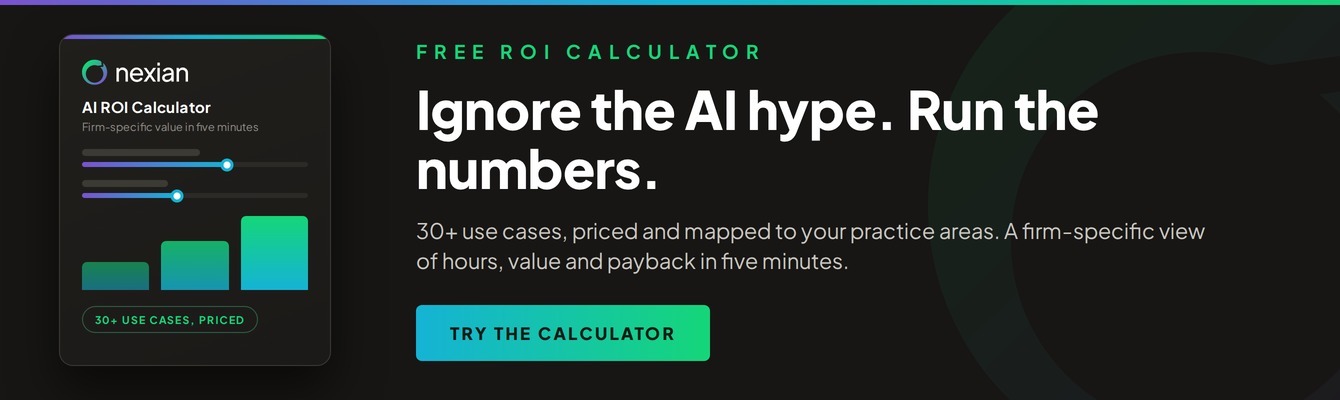
Our free calculator filters the 46 use cases to your practice areas and your PMS, and puts an illustrative figure against each: hours reclaimed, annual value and payback. Five minutes, no obligation, and every figure flagged as illustrative rather than a quote.
Sources
[1] Thomson Reuters research on potential AI time savings (~240 hours per lawyer per year), as cited on Nexian's AI ROI Calculator landing page.
[2] Clio research (74% of hourly billable tasks exposed to AI), as cited on Nexian's AI ROI Calculator landing page.
[3] Ayinde v London Borough of Haringey [2025] EWHC, referenced in coverage of solicitors' duty to verify AI-produced citations, e.g. SpotDev's AI for Law Firms guide.
Download the
Whitepaper
nexian.co.uk/legal-modern-workplace-whitepaper
Or get in touch with the team if you would like to talk through where your firm is on its technology journey.